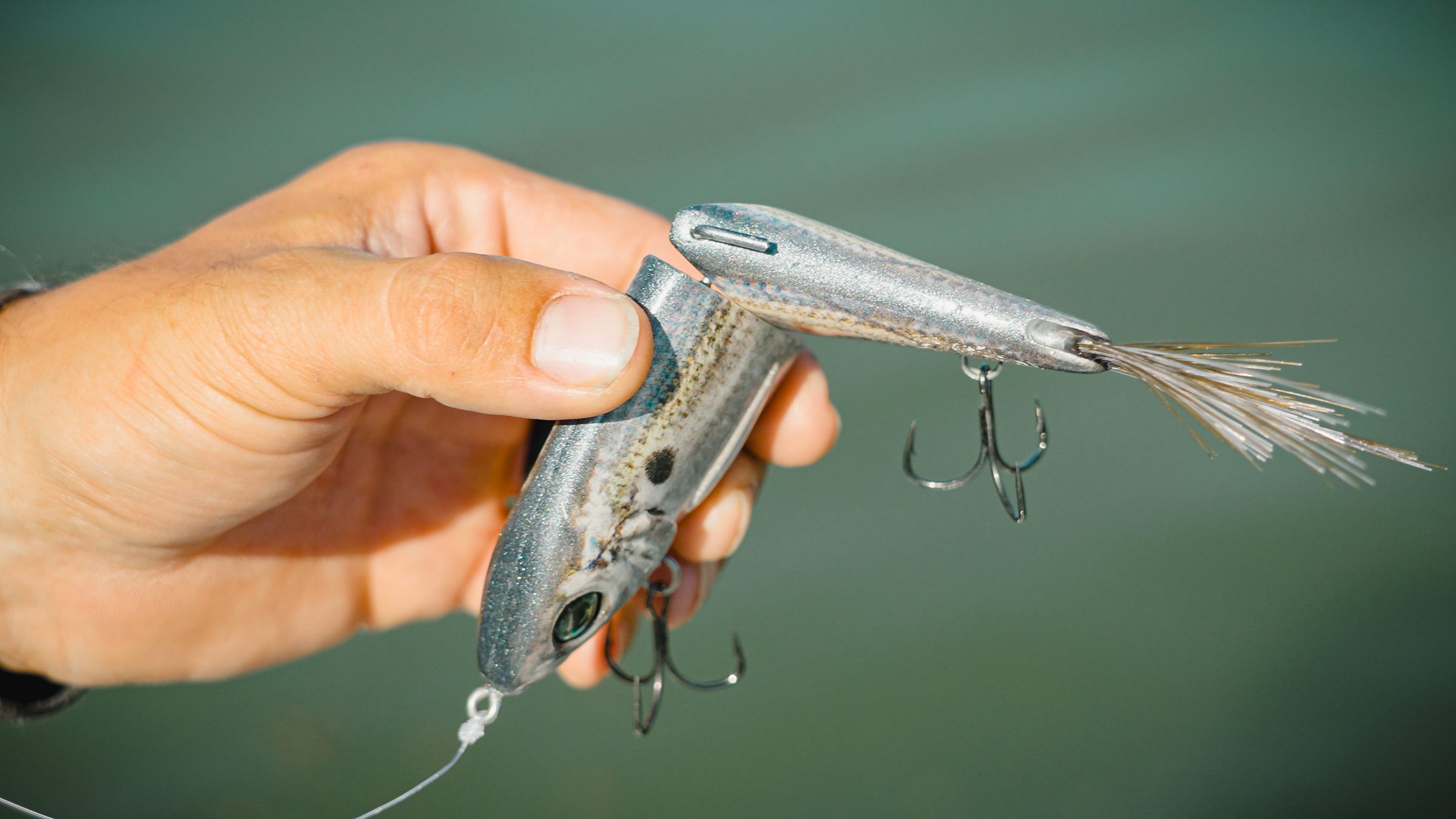
If you've never thrown a glide bait, the first few casts can feel strange. There's no lip to dig, no blade to thump. The bait does exactly what you tell it to, and that's the whole point. Learn a handful of cadences and you can make one bait look like a lazy cruising baitfish, a fleeing shad, or a wounded meal hanging right in front of a big fish's face.
1. The steady glide
Point your rod tip at the bait and just reel. A slow, steady turn of the handle gives the glide a nice head hunting action on its own. This is one of the bread-and-butter retrieves and it catches a lot of fish, especially when they're cruising and not chasing too hard. Our baits stay stable at literally any speed, so you can slow-roll it or pick up the pace without it rolling over or blowing out.
2. The Chop (NO rod pops, ONLY handle turns "Reel Chops")
Give the reel handle several, with a mixed up cadence, quick quarter turn reel chops. Ensure you are taking up the slack and do it again. Every input sends the bait the opposite direction, so you get that classic "walking" path. Short, quick inputs make short darts; longer sweeps make long, lazy glides.
3. The chop and burn
When fish are fired up, get aggressive. Sharp, back-to-back reel chops make the bait chop and snap side to side in place, and burning it back fast triggers reaction strikes. Clear water and active fish are when this shines. Don't be afraid to throw a hard 180 turn in there when you run out of real-estate for a last ditch effort for a reaction strike . A good glide can take it.
4. The dead pause
Sometimes the best move is no move at all. Stop reeling and let the bait hover. A bass that's been following will often eat the second the bait stops. This is especially deadly in cold water and on fish that are sitting suspended.
Mix it up
Don't marry one retrieve. Try two or three in the same cast: glide it, walk it, kill it, then burn it. Pay attention to what you were doing when a fish showed up, and do more of that.
Turning followers into bites
Big fish follow glide baits a lot. That's not a bad sign. It means they're interested. When you see one behind the bait:
- Change speed. Speed up for a few turns, or kill it dead. A sudden change is what triggers the bite.
- Make it turn. A sharp twitch that sends the bait off to the side looks like a baitfish trying to escape.
- Don't pull it out of the water. Keep it moving at the boat. A figure-8 or a few direction changes beside the boat closes a lot of deals.
- Make long casts. The farther the bait travels, the more time a fish has to find it and commit and the better the glide will perform.
A few quick tips
- Cast well past the target and swim the bait by the cover instead of landing right on top of it.
- Check your hooks, line and split rings before every trip. A big fish will find any weak spot.
- Keep the net ready. Glide fish tend to be big ones.
Tie one on, give it some time, and stay patient. Once you get that first big one to eat, you'll understand why anglers get hooked on throwing glides.
Questions & Comments
No comments yet. Be the first to ask a question.