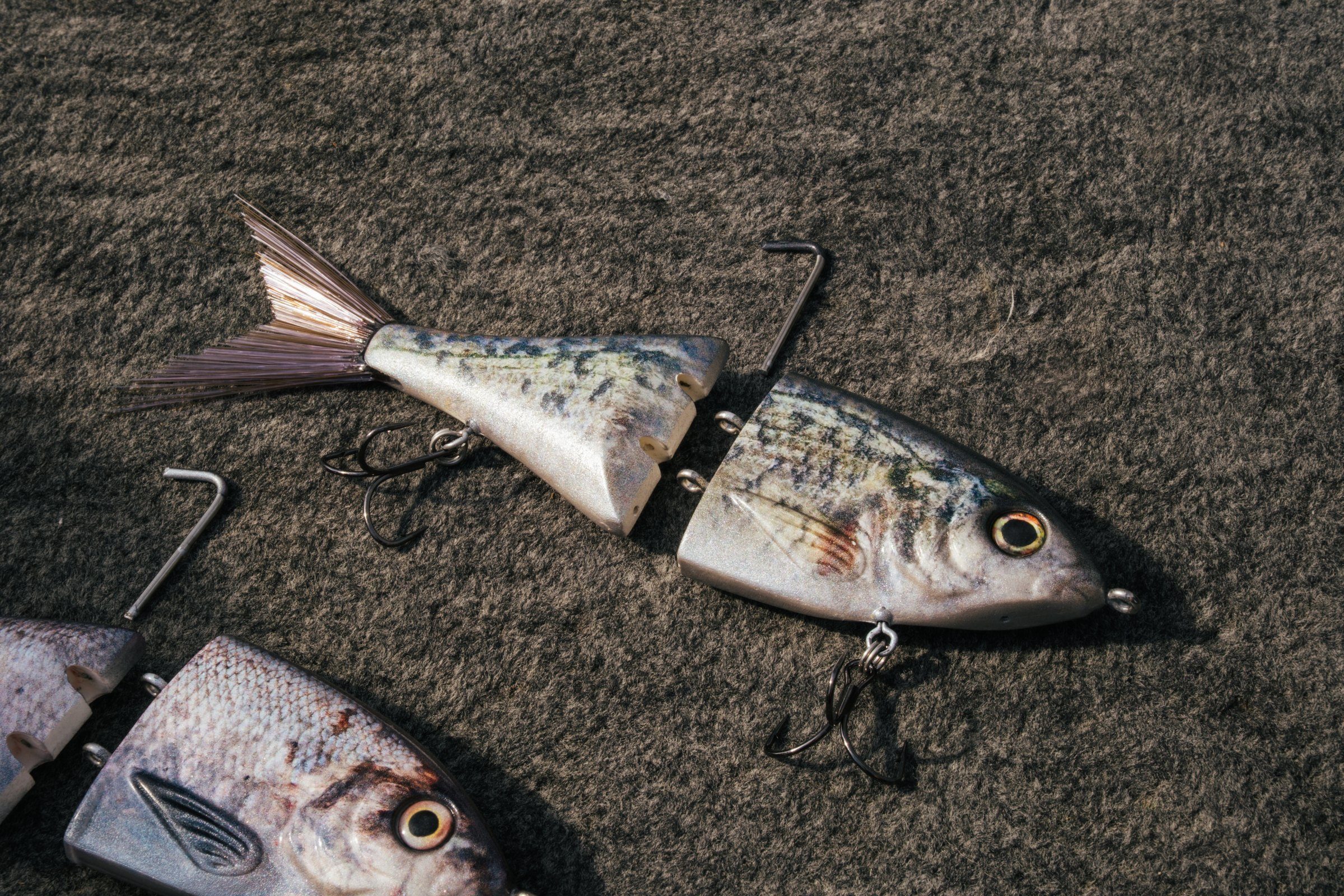
Every Versatile glide is tank tested before it ships, so it should run true right out of the box. But glides get fished hard. A big fish, a snag, a hard hit on a rock, or just a long season can shift the joint a little. When that happens, a two-minute tune gets your bait swimming right again. Tuning also lets you change how the bait performs to fit the way you like to fish it.
Signs your glide needs a tune
Swim the bait right off of the boat where you can watch it. It needs a tune if it:
- Leans and swims on one side instead of coming straight back upright.
- Glides wide one direction but short the other.
- The glide wants to nose up or down.
- Has a joint that doesn't swing freely.
What you need
- The pin of the bait or a pair of pliers (needle-nose or split ring pliers work great).
- Water to test in: the lake, a pool, or a tub.
- Somewhere to tune it so hardware doesn't get dropped and lost
Step 1: Look at the gap
-Hold the head of the bait with one hand and the tail with the other and pull it apart and inspect the joint gap between the head and tail section. If the gap isn't even go to Step #2 for the correction process.
-Hold the head of the bait with one hand and the tail with the other and look over the top of the bait and ensure the head and tail are aligned evenly, do the same thing on the bottom. If they aren't aligned properly got to Step #3 for the correction process.
Step 2: Remove the Pin
The two halves are held together by a pin that runs through the screw eyes in the joint. Grip the pin firmly with your fingers or pliers and turn it 90 degrees. Then give the pin a wiggle back and forth while pulling it straight out at the same time. Work over the towel or the boat deck. That pin is small and loves to hide sometimes!
Step 3: Joint gap isn't even
With the pin out, you can turn the screw eyes in or out:
-If the gap is bigger on the bottom, unscrew the top or screw in the bottom a half turn. Assemble the bait and retest. -If the gap is bigger on the top, screw the top in or the bottom out a half turn. Assemble the bait and retest. -Ensure that you haven't tightened them in so far that the tail section is catching on the head section. If you get the gap joint set correctly then unscrew the top and the bottom evenly until the tail section swings freely.
- Always turn in half turns. Half a turn (180 degrees) brings the eye back around so it lines up with the others so the pin slides back through.
- Screwing in pulls the two halves closer together and closes the gap.
- Screwing out pushes them farther apart and opens the gap.
- Count every half turn you make. That way you can always get back to where you started.
Step 4: Head and Tail aren't in a straight line
With the pin in firmly grip the head of the bait with one hand and the tail with the other, then twist your hands in opposite directions (like you are ripping a phonebook). Do this in small increments and recheck your alignment after every attempt. Check this on the bottom and the top the ensure the bait is aligned properly.
You can also tune the action to your liking. On most glides, a tighter joint gives longer, smoother, sweeping glides with more hang time, and a looser joint gives a quicker, tighter, choppier action. Try a half turn either way and see what the fish like.
Step 5: Test it and repeat
Throw it and watch it swim beside the boat. Still not performing to your liking? Pull the pin and make another half-turn adjustment. It usually only takes one or two tries to get it dialed in.
A few cautions
- Don't force it. If a screw eye won't turn easily, stop. Forcing it can snap the screw eye. But it will be firm and make popping sounds when turning on occasion.
- Don't run the eyes in too far. If the halves touch or the joint binds, back each one out a half turn.
- Check your screw eyes, split rings, and hooks after a big fish. A big one can bend hardware. Straighten or replace anything that's tweaked before your next cast.
Still can't get it to run true? Reach out to us. We're happy to help you get your glide swimming right! We stand by our product!
Questions & Comments
No comments yet. Be the first to ask a question.